Friday, March 16, 2012

Blog #8: All is movement, all is sensation. Dynamism.

                        The 8th group's topic is the 20th Century Art. Apart from modern art, 20th Century art put aside the traditions of the past in a spirit of experimentation. They started a world of experiments. They created new ways of seeing things in an artistic way. This is the era where the advent of Abstractionism took place. 

                        20th Century art consists of many styles, and among those styles, Futurism is what I like the most, for it follows a principle called, "Dynamism". According to their report, dynamism, "defined as the theory that force or energy is the basic principle of all phenomena. All is movement all is sensation." From the word itself, dynamic, full of energy. Here's an example of dynamism, The Street Light by Giacomo Balla:

by: Giacomo Balla

                         For Giacomo Balla, dynamism is more important than the subject matter, the movement is more important than the thing itself. In this painting, it shows that the subject is in constant movement, and that leads you to see the movement, not the subject. That's how artists of futurism see things, remarkable. Creating a masterpiece as that is really difficult to achieve, you'll need a richer imagination to see things as that.

                         As an aspiring artist, such a work as that is one of my goals to attain someday. To see things in a different way ordinary people could. To develop a richer imagination, see things in an artistic way, where "all is movement, all is sensation." (8th group)

Sunday, March 11, 2012

Blog #7: Leading Lights = Grandeur

                       Modern art is the topic that was discussed by the 7th group. According to their presentation, "modern art begins with the changes in the representation of space as introduced by artists of the late 18th century. Unlike Renaissance masters, who sought to open up endless vistas within the canvas, the artists of the latter 1700s thrust all of the imagery toward the picture plane. The flatness or two-dimensionality of the canvas surface was asserted by the use of planar recession rather than linear recession." 

                       Modern art, covers powerful styles, that made it more interesting. One of them that I like the most is the Impressionistic style. Impressionism is a style that conveys emotions, opinions and personal views of the artists. In this style, we can say that art speaks. In this style, artists make their own rendition of things when perceived by the light. Here's an example of an Impressionistic art:
  
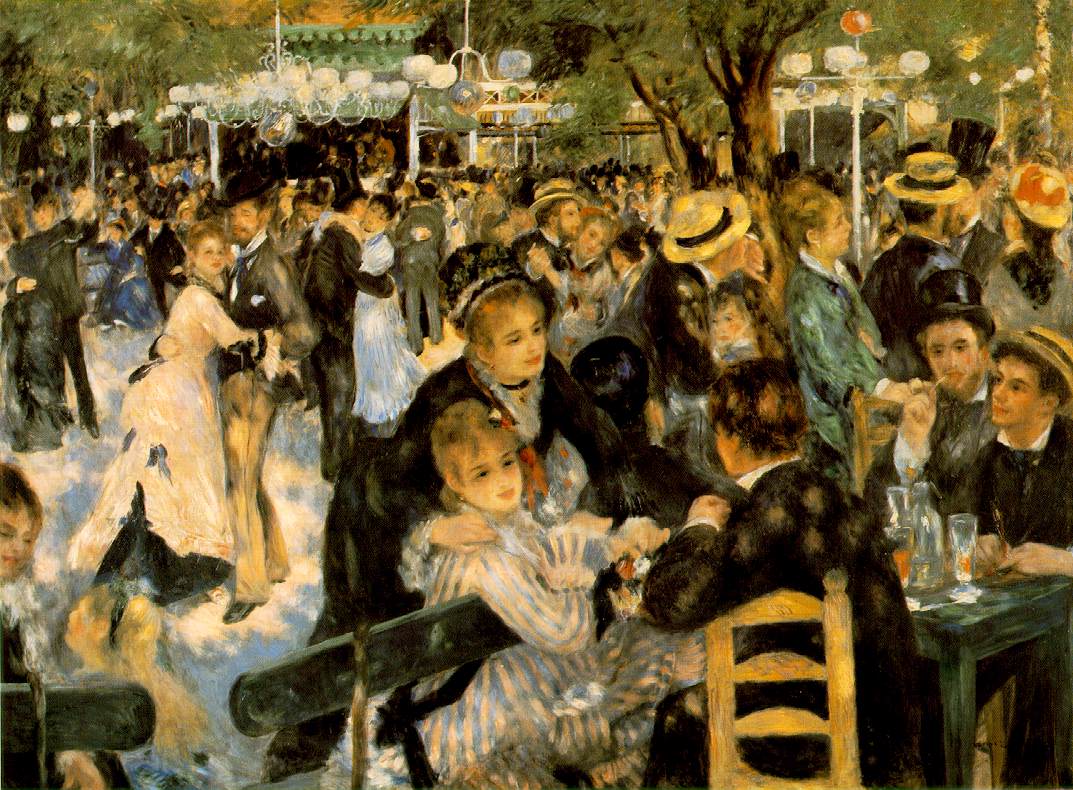
Le Moulin de la Galette
by: Pierre-Auguste Renoir (1841 - 1919)


                       But in this case, the artist, Renoir, didn't just portray things when perceived by the light. He painted a scene that seemed like it just happened yesterday. He used the "leading lights" composition, it's when you look at the painting from the bottom left, the light will lead you the center then to the top-most right then back to the top-most left which is the main subject. It's a very powerful technique and is very difficult to do.

                       Digitally, creating a masterpiece as that is really hard to do, what more if it's a painting (from scratch)? It's really remarkable and amazing. I, for one, would want to create a masterpiece as that!! I want to use this painting as my inspiration to create my own. No photograph can match a grandeur painting as that!

Friday, February 24, 2012

Blog #6: Art Excluding the West

                       The 6th group discussed the Arts beyond the West, and obviously these are arts excluding the western part of the Earth. Its styles are: Naturalism, Expressionism, and Figurative. But most of their art focused on their religion wherein they used Expressionism and Figurative style. 

                       Arts beyond the West are very impressive and made in detail. It may look simple but if you would look on it closer you would see the details and know how hard it could have been made. We should also be influenced by that, being diligent in creating a worthwhile artwork.


                       But since this art also covers Asian art, I would like to focus on it. China in particular, who influenced almost all of us and not just in ancient times but up until now! Good thing about Asian art is that their art is not just for the art itself or the typical only-for-display art  but also useful in our everyday lives.
                       Personally, I want to create the same art, that I can always use everyday, so that I can always see my creation as well! And that's something to be proud of. I really think that's the characteristic that we should inherit from them, to create a masterpiece that would be useful in our lives!

source

Friday, February 17, 2012

Blog #5: An Art Caught on Act

                       I belong to the Group 5 and we discussed about the Baroque period. Baroque period ranges from 1600 to early 18th century. A continuation of Naturalism and Classicism of the Renaissance period. Characterized by Motion, Tension, Drama, Detail and Grandeur. Compared to Renaissance, which showed the moment before an event took place, Baroque artists chose the part when the action was occurring. That made it unique from other art periods. And also the thing that impressed and made an impression to me.


                       It's really hard to capture an event using paint brush, like really, an on-going event. And that's how remarkable Baroque art is! And not just because it's in motion but also because of other characteristics that made it really impressive. One is tension. How Baroque artists showed emphasis on a particular subject. The use of lights and shadows. Another is the drama. Every Baroque art has its own historical background or scenery  that made it more interesting to the viewers. Another one is detail. If you would observe one Baroque art, you would notice how detailed it's been created, 
that it seem like it's captured by a camera with a very high shutter speed (for it's in motion). How hard is that? Really hard! And lastly, Grandeur. If you would combine the 4 characteristics given, then you'll find the art impressive! How the scene was depicted perfectly. How complete the Art is!!

                       I also liked the idea that they used models form the street, unlike the previous eras that used characters from the bible, myths, legends, and many other fictional characters. Baroque artists portrayed the things that occur around them, and gave the ordinary people a chance to be the subject, the center of attraction or of an art. Just like nowadays, anyone can take a picture of himself and upload it to the net for everyone to see, it's just that it lacks in style. 

                       I always thought about how great previous artists are, and how creative their minds are! Which inspires me to strive harder and practice harder in order to reach or even just to follow the lead of "the Greats". It's not bad to dream high, reaching it is the problem. We should continue to pursue styles as this period possess and make a difference. And create an art caught on act! :D

Friday, January 27, 2012

Blog #4: Rinascitá


                       "Rinascitá" is an Italian word meaning, "rebirth or "reconstruction", according to the fourth group's report, where the word, "Renaissance" came from.

                       Renaissance is the period where art broke away, reconstructed into a wider range that it was no longer centered on religious things but also on the feelings artists have. Artists then had the freedom to express their emotions through arts, that everyone could relate to, not just the Christians. Art became a universal language. Arts became more alive! Renaissance is also the period where famous styles began or emerged. Different styles were then created and many artists benefit from them, even until now. During this period, art was more appreciated, it's free from everyone. And I think it's the most influential art of all, 'cause art was revived from scratch.
                But Renaissance doesn't just focus on other things, in this period different versions of interpretation emerged. Though freedom of expression was practiced, Classical and Christian art was not forsaken. Artists even made their own version of some of the artworks from the Classical and Christian Art, they just differ in style. We'll then see from there that their inspirations were still from their ancestors. Renaissance art is a really interesting period, almost everything that we know now about arts are originally from this period. We owe them and should continue to enrich our artistic skills. We should also make a difference that our offsprings or the new generation will feast upon.


Let's leave footsteps that are worth walking in to. Let every artistic skill count.

Tuesday, January 24, 2012

Blog #3: From forbidden to unforbiden.


                       As we all know, during the Christian Art period, Christianity is strictly forbidden, illegal to be exact, but Christians didn't seem to mind it, in fact they built catacombs underground to support their religion, and that's one thing to admire for us, Christians. And the fact that the moment Christianity was legalized, they suddenly want the whole world to know by the use o f art. Well, who wouldn't do such thing after being hid for several years, right? I truly admire their devotion to their religion that it became the center of their lives and also the center of art.

                       Of course it's a good thing to center the Almighty in our lives but it doesn't necessarily have to mean that we shouldn't think of anything else. We should still have to balance things, unlike in Christian Art period, they focus only on religious things, I'm not saying it's bad, but how about the true art, the true feelings most people have?  They can't just leave them behind? Also, the interpretation of most of the events in Bible became the seed of contention, competition as to who can interpret it the best, and if we would talk about God, we shouldn't think like that, we should be in harmony with each other.

                     We should all be grateful that after years and years of waiting, Christianity was then legalized and we, the new generation, can no longer experience persecutions and all that. Christianity unites people, having one belief and faith. There is only one God, though there may be lots of religion but we worship and believe in just one and true God. Thanks to our ancestors that made it possible for Christianity to be legal and that we are now enjoying the freedom express our beliefs. Christianity can't be stopped, from forbidden to unforbiden.

Thursday, January 12, 2012

Blog #2: Art as Language

                       The second group discussed about the classical art, and I can say that they did a really great job! They explained everything we need to know and really got everyone's attention, or maybe because it's about the Greek & Roman art wherein every art is attractive—but still they did a great job! And one particular subject caught my attention. I don't want to stick to the common subject, "the conquered became the conquerors, and the conquerors became the conquered,” rather, I want to ponder on what the reporter discussed about the "Dark Ages" wherein art is the only language the people back then used.


                       Nowadays, some use art just for fun, neglecting its value and taking it for granted while it should be used as language. And that's what I learned about classical art. Feelings are really hard to express that even you yourself find it unfathomable that it's best to express it through art and let them know what your true feelings are and to know for yourself who you really are. Some might think that they already know who they are but until they create an artwork expressing their inner selves, then came the time for them to know who they really are. Even you can try and do this and know for a surety that art is indeed a better notepad of your feelings.

                     Use art as language, just like when you're talking to a very important, famous or "big time" person—with utmost respect. Let's not waste the use of art, instead treasure its use be grateful for it's existence.C